Showing posts with label Thailand. Show all posts

Tuesday, 15 March 2011

Martin Wheeler ฝรั่งหัวใจไทย


Living a rich life

Martin Wheeler's wealth comes in bundles of happiness


Most of us like to read stories about rich and successful people, to see how they made it to the top.
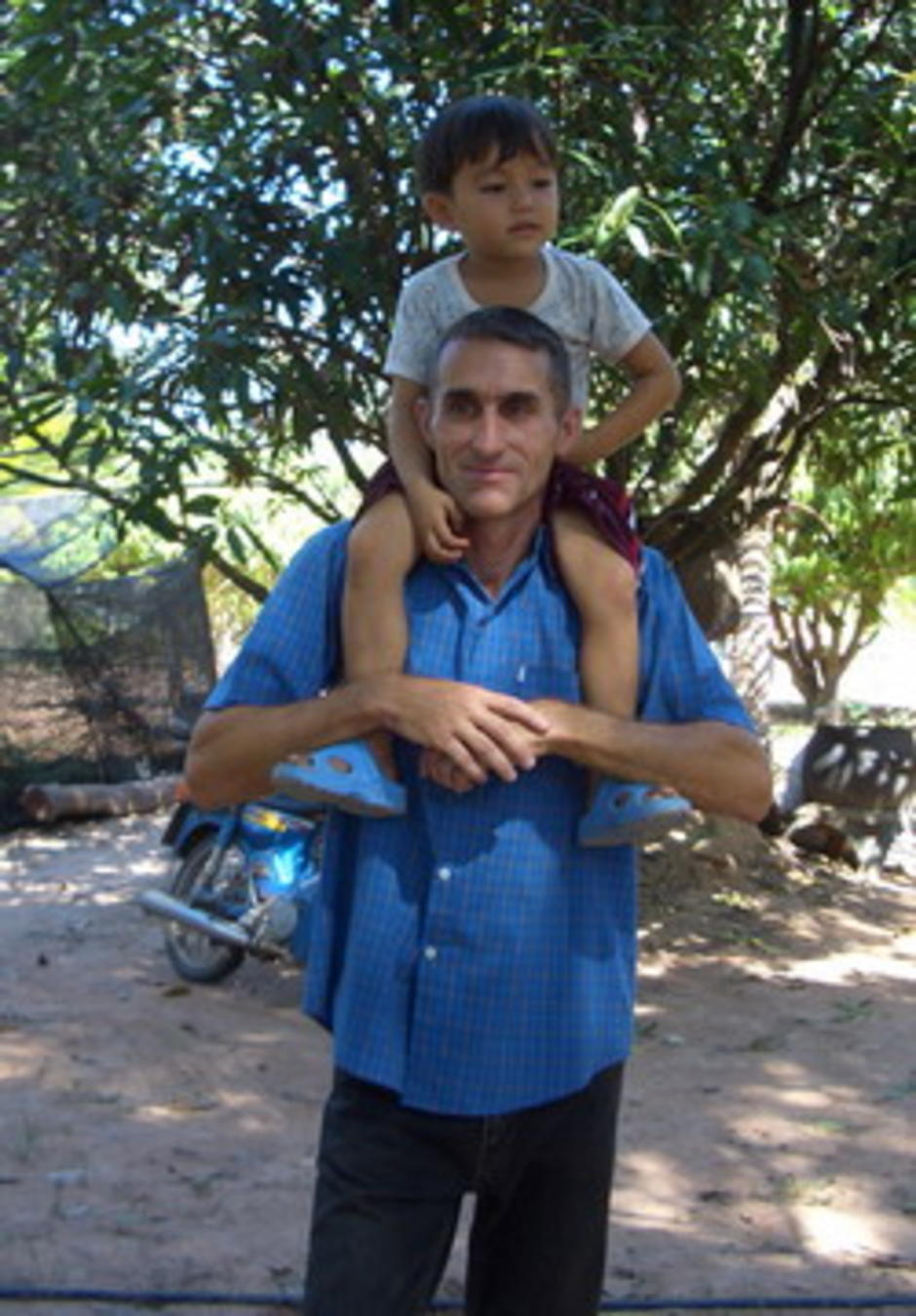
Martin Wheeler and son

This will also be a story of a rich man. However, "rich" in this case does not refer to money, but happiness.
This man doesn't own a giant company, nor does he own any buildings, but he believes he has it all.
He says the implementation of the King's sufficiency economy theory can make his life complete.
It's the strangest thing to hear all these thoughts coming from the mouth of a non-Thai citizen. Interestingly enough, this farang seems to far better comprehend the King's idea than most Thais.
This 47-year-old Briton is named Martin Wheeler. He eats rice and the organic vegetables he grows. Even some rich people, when they hear about his life, can't help feeling a twinge of jealousy, and puzzlement at how he managed to detach himself from the mainstream life that is dominated by greed, money, ambition, competition, and the like.
Mr Wheeler currently lives at Baan Kham Pla Lai in Khon Kaen, with a Thai wife, Rojana Wheeler, and his three children. He has spent a total of 17 years in Thailand and eight years have been spent in this remote community.

He says he eventually found real happiness after a long quest from England.
Mr Wheeler, who graduated with first-class honours in Latin from London University, turned his back on his career and decided to take up the simple life in rural Thailand.
"Personally, there is something more valuable in life than money," he said in fluent Thai, with a northeastern accent.
"Is money not significant?" I asked. No, he answered.
Mr Wheeler doesn't refuse the importance of money: He needs it too, to buy things for himself and his family and keep everything running smoothly.
But he never allows money to have an influence over his life.
"Having more money makes our life more complicated and unhappy sometimes ... I look at money as a drug that puts our life in danger," he said.


Though well educated, he has worked as a labourer earning less than 100 baht a day. He once decided to spend all his remaining cash to purchase clothes, shoes and other accessories to make himself look good enough to get a job as an English teacher in Bangkok.
However, as time went by, he eventually quit as he felt he had betrayed himself by doing something he disliked for money.
Currently, the couple owns 47 rai. Ten rai are used to grow jasmine and sticky rice, seven rai for pterocarpus macrocarpus (Mai pradoo), diptercarpaceae and dipterocarpus alatus trees, and a rai for vegetables. She helps by doing the household chores and field work.
They live simple lives. She cooks rice that comes from their own farm; the vegetables they eat are harvested from their own land.
I joined the couple for a lunch that included purple-coloured rice and three Isan side dishes.
She said the rice was old, and had lost its gentle aroma. To boost it, a few drops of the liquid extracted from butterfly pea, a type of local flower, were added.
The pair spends less than 200 baht on daily living. This money includes paying for electricity, water and gas.
- Theory of sufficiency economy
His quest for freedom and happiness led him to become a strict follower of the King's philosophy.
However, he believes many Thais have a tendency to misunderstand the theory.
The major problem at the moment is the term "enough": People have widely varying definitions of it.


That is why the theory hasn't really blossomed, he says.
"Similar to a way of Buddhism, people are told to rely on themselves, not on others, and walk in the middle path. It is very logical for human life at present," he explained, adding that even though he does not follow any religion, he does like the teaching of Buddhism.
Mr Wheeler says three prime guidelines can help create a sustainable community, particularly in rural areas.
First, people will have to rely mostly on themselves with the resources they already have.
Second, agricultural output can be distributed commercially under the one-tambon one-product (OTOP) scheme.
Third, an enterprising community will set up ways to work with the government to spur development.
While implementing the concept, problems may arise when people are immature, he added. Some may bypass subsistence agricultural production to focus only on producing OTOP products for commercial purposes. But this won't help create a solid foundation for the community, he said.
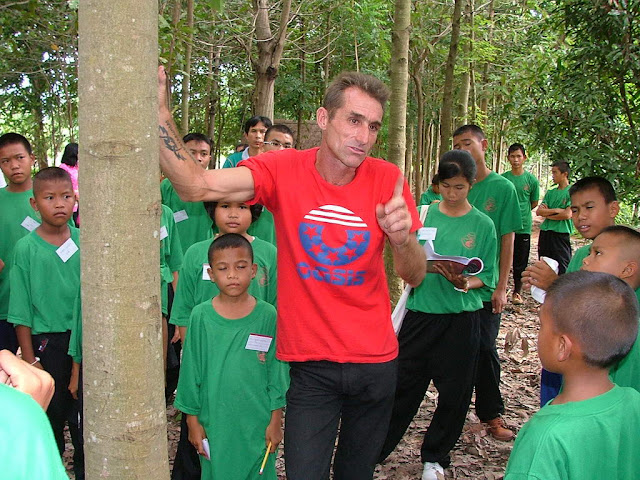
Today, Mr Wheeler speaks about the sufficiency economy in his local community and others.
The man has been a role model in his community by showing them how to live happily and sufficiently, given the scarcity of natural resources in the area.
First, he said the attitude towards being rich among rural northeastern people must change. They must accept the troubles they face.
For example, the soil is not as fertile as other regions. Plus, when the dry season comes, they face a severe water shortage. The chance of obtaining a proper education is rare. It is tough for the local people to make a living.
So, what to do? He said they should look for ways to maximise the resources in the community. All hands are needed to work cohesively.
For example, the community he lives in now has been developed with the efforts of Ubonrat Dam Hospital. The pilot project, based on the framework of the Four Noble Truths of Buddhism, gave a platform for community members to discuss and analyse the problems they have and seek solutions.
- Being happy in the rice field
Mr Wheeler wakes up 5.45am and arrives at the rice field at 6am. He normally spends 6 to 8 hours working there if the sun is not too strong. He walks in the field with bare feet and his feet get wounded by sharp objects.
His routine is to pull out the weeds in the rice field and look after other crops. When the rice-growing season comes, he ploughs it himself, unless he feels too exhausted. Then he will consider hiring local workers to help.
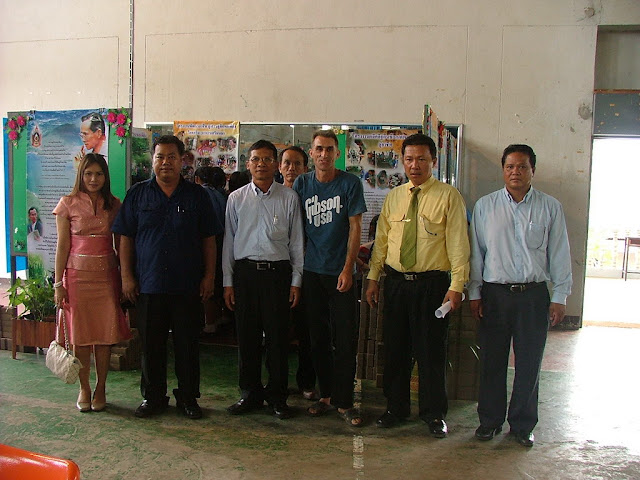

When asked if he used to feel discouraged and want to do something else, he answers: "No. All that I've done I've already chosen and so I'm happy with my choice now."
He produces about 100-150 sacks of rice annually. All are kept in the barn for family consumption and also for visitors coming to learn about the concept of sufficiency economy he practices.
Whenever a group of visitors arrive, his wife and neighbours will cook and serve Isan dishes and bananas grown in their fields, for about 70 baht per person.
Mr Wheeler's speaking fees generate an extra 15,000-30,000 baht each month.
Economically, he said, Thais are very lucky. Many lost their jobs during the recent economic downturn. However, they still have houses to live in and food to eat. They also have their own land to grow plants and food.
Compare that to British people who own no land and house, he said. They rely heavily on staying employed because they live in rented houses.
So where is the happiness in that sort of hard life?
- A happy family
Today, Mr Wheeler's family lives in a small wooden house he built himself. In the past, he said, he lived in a cottage.
He provides education for his children, but just enough for them to become strong enough to fly out of the nest. He has never forced them to take up any money-making subjects.
He teaches them to know their abilities, and not to follow social trends. He does not want them to enroll in a mainstream academic programme, filled with fierce competition and pressure.
"Even though the English language is an advantage in today's society, I have never forced them to talk or learn it from me. At home, we speak two languages - Thai and Lao," he said.
Currently, the oldest boy, 14, is studying in Khon Kaen and the second one, 12, is studying at the College of Dramatic Arts in Kalasin.
When they grow up and have nowhere else to go, "home will be their shelter. Happiness is guaranteed here, even without much money.












Sunday, 20 February 2011

Thai Wedding Making Merit


By Richard Barrow | Posted in Thai Culture


Thai Wedding Making Merit
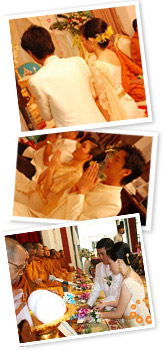
There are an increasing number of foreigners who are marrying Thai women or Thai men. And according to our ThailandQA.com Forums, there are also many people coming to Thailand to attend weddings as guests as they are asking questions like “What do we wear to a Thai wedding” and “What gift do we give the bride and bridegroom?”. As I was at a Thai wedding last weekend, I thought I would share with you some of my photos. I was the official photographer (I also do funerals but that is another story) so I took about 1,900 pictures on this day. I have been to quite a few weddings in Thailand, so I will try my best to give you an explanation of a typical wedding. These may vary throughout the country but most of them typically have the same elements. In urban areas the wedding might only last for one day, but upcountry the celebrations often go on for three or four days. These are pictures of a typical wedding in Central Thailand.

A Thai wedding in Thailand is not your typical wedding that you may have experienced in your home country. There is no church wedding as such as the first ceremony usually takes place at the home of the bride or the new home of the wedding couple. Traditionally, an odd number of monks, usually nine, are invited to bless the home of the wedding couple and also all of the participants in the upcoming wedding. The wedding cannot take place on just any month of the year or even day or time. Auspicious months for a wedding are usually days in the waxing phase of the moon on the second, fourth, sixth, eighth and twelve lunar months.

These are all even months as the number two represents the couple to be married. The ninth lunar month is also considered to be lucky. However, you should never get married in the tenth lunar month as it is considered very unlucky for your marriage. This is to do with dogs who are usually in heat at that time of the year. No-one wants to be associated with copulating dogs. Once the month is chosen, they then consult an astrologer who will then choose the precise date and time for the ceremonies to start.

The monks are invited early in the morning. Usually for this part of the ceremony, only close family and friends might attend. The five precepts are first recited and then the monks chant auspicious text from the scriptures. While this is being done, some water in a bowl, with a candle dripping over it, is being made sacred. At the completion of the chanting, the wedding couple simultaneously, again representing their unity, offer food to each of the monks. After the monks have finished their meal, the couple then make another offering of flowers, money in an envelope and essential items for every day life for the monks. Any merit made during this ceremony is then passed onto ancestors and absent relatives by doing “kruat nam”, where water is poured from a container slowly into a bowl. The head monk will then mark the foreheads of the couple with three dots using paste which was blessed during the ceremony. He then blesses the couple with the holy water.

 As the monk departs, he will sprinkle water over the other guests. To receive the blessing in a proper manner, you need to put your hands together in a prayer-like gesture.

As you can see by the above picture, most guests are sitting outside the house at round tables. They are being served food and drinks. Though, strictly speaking, they cannot start eating until after the monks have finished their own meal. Inside the house were the parents and grandparents of the couple to be married. Everyone else was outside. When you receive a wedding invitation, you will often have the times for three different ceremonies. Quite often these days, they are held on the same day. For this wedding, the ceremony to be blessed by the monks and to make merit started at 7 a.m. and lasted over 90 minutes. It might be a bit boring with all the chanting and if you are not a Buddhist then there isn’t much you can do other than eat and drink. In addition, you will most likely be sitting outside so will only be able to hear the chanting.

Most people don’t turn up for this part. Or, if they do, they will arrive late. You don’t have to wear anything formal, just something smart. This is now the end of the first part of the wedding day. The couple are not married yet. They have just received a blessing from the monks. The monks now leave and don’t take part in the next ceremony.


http://www.thai-blogs.com/2008/08/23/thai-wedding-photos/
Related Blogs and Articles: Probably the most famous Thai Wedding on the Internet was of Thailand’s famous Internet teenager, Panrit “Gor” Daoruang. You can read all about his wedding and see the photos at thailandlife.com. About three years ago, I wrote a popular blog called How to Get Married Cheaply. It was a kind of mass wedding ceremony where a group of couples got married at the same time. Our Steve wrote about his own wedding in a blog called Getting Married……In Thailand and our resident Thai blogger, Oakmonster, writer about her Thai wedding in America in Temple of Love. Finally, if you are dating a Thai girl or boy, then you might find our Relationships Forum useful as it helps with cultural misunderstanding and procedures like meeting the family for the first time. You need to register to see this forum. It is quick and free to do so
 

Saturday, 19 February 2011

Bathing Ceremony


During the three days of Songkran people flock to the wat in their best clothes. They bring with them candles, joss sticks, flowers and small bottles of Thai scented water called "nam ob" or water saturated with perfumes. At the wat shrine each devotee lights a candle and three joss sticks and places them together with a single flower or a bouquet in a receptacle in front of Buddha's altar.

Bathing Ceremony in songkran day


The worshippers then make obeisance to the Buddha by partly prostrating themselves thrice before His image in a prescribed form. Each worshipper kneels with his hands placed palm to palm raising them to the forehead in a worshipful attitude and then prostrates himself on the floor with the hands now separated to allow the forehead to touch the floor between the palms. Such salutation is called "benchangapradit" from the Sanskrit "panchangapratishtha" (fivefold body worship, i.e.. with the forehead, two palms and two knees resting on the floor). Such salutation among the Thai is the highest form of respect. Salutation by full prostration on the ground and "kissing the earth with the forehead" is unknown.
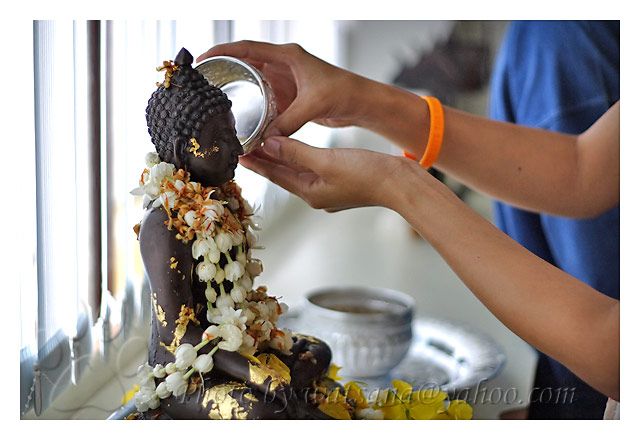
After worshipping in this manner, a little quantity of the scented water is poured on the hands of the Buddha image. Such a ritualistic act is called in Thai "Song Nam Phra Putha Rup" (bathing the Buddha image.)

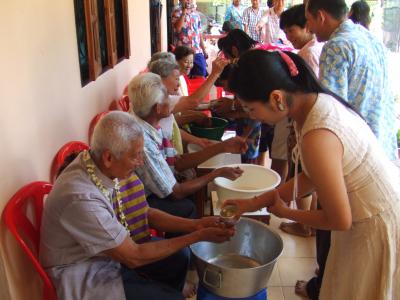
Not only do the Buddha images in Thailand receive the ceremonial bath, but elders of the family and elder monks may receive it too. Here is an account of the bathing of family elders. In Bangkok, especially among the upper class, people are want to make a traditional call on their elders to pay their respects during Songkran. This they do by pouring scented water into the palms of the elder who will then duly rub it lightly on his head and face. The elder, in the old days, would then be presented by the visitors with a "phanung" (loin cloth) and a "pha khao ma" for a male or a "pha hom" for a female, both of which constituted everyday wear in those days.

Bathing Ceremony


Nowadays the elder is presented with a towel, a box of handkerchiefs, a box of soap or other such articles and sometimes with a bottle of scented water. After the presentation the elder will bestow his blessing and best wishes upon the relatives for the New Year.

A gift of a bottle of scented water is specially appreciated by the older generation who are want to smear themselves during the hot season with a preparation of soft chalk powder called "din saw phong" mixed with scented water which is refreshing to the skin. Sometimes the powder is ready-mixed with attar of roses and may be applied lightly with a towel or handkerchief. Such toilet preparation is called "paeng sod" or fresh toilet powder.

In the old days, the ceremonial bath was the regular family thing. The elder would seat himself on a broad bench. The children would assist him in the bathing by pouring the scented water on him. They also would furnish him with a new set of clothing to be worn after the bath. Further they would present him with the traditional candles, joss sticks and flowers emblems denoting the highest respect among the Thai.

We now come to the ceremonial bath of a monk. It may take place on any of the three days of Songkran. The monk is usually the abbot of the monastery, who is invariably held in high esteem, usually old and, in the case of a village wat, a leading personage in the community life. People call him "Luang Phaw" (Great Father). He is not only their spiritual father but also their adviser in temporal affairs in the light of his recognised wide knowledge and experience. Sometimes he combines the versatility of doctor, astrologer and adapt in the mystical and magical arts separately or all rolled into one.

Bathing Ceremony


He is always an unquestioned mediator in disputes; the villagers, in most cases prefer to abide by their "Luang Phaw's" decision rather than report to the courts or other local authorities.

It is not difficult to see, therefore, that such a man would command hosts of disciples falling over each other to do him the traditional honour of a ceremonial bath. But in such cases a notice is circulated before-hand specifying the exact day and time of the ceremony which is the same as for the elder of a family. After the bath the abbot gives a sermon followed by his blessing for a happy New Year.


http://www.thailandlife.com/songkran-festival/bathing-ceremony.html

Songkran festival Thailand


Songkran day or family day
songkran day

The Songkran festival is celebrated in Thailand as the traditional New Year's Day from 13 to 15 April. It coincides with the New Year of many calendars of South and Southeast Asia.
songkran day Thai people went to the merits at temple
songkran day

The date of the festival was originally set by astrological calculation, but it is now fixed. If these days fall on a weekend, the missed days off are taken on the weekdays immediately following. If they fall in the middle of the week, many Thai take off from the previous Friday until the following Monday. Songkran falls in the hottest time of the year in Thailand, at the end of the dry season.
songkran festivals thailand

Of all the feasts and festivals in Thailand, which are many, the Songkran Festival is the most striking, for it is widely observed not only in this country but also in Burma, Cambodia and the Lao State.
Songkran is a Sanskrit word in Thai form which means the entry of the sun into any sign of the Zodiac. But the Songkran in this particular instance is when the sun enters the sign of Aries or the Ram. Its full name is Maha Songkran or Major Songkran to distinguish it from the other ones. But the people call it simply the Songkran for it is the only one they know and in which they take interest. It is their traditional New Year when they can enjoy their holidays to the full with no economic hindrance. The Songkran is in fact the celebration of the vernal equinox similar to those of the Indian Holi Festival, the Chinese Ching Ming, and the Christian Festival of Easter. The beginning of spring when the sun crosses the equator is now on the 21st of March which is due to the precession of the equinox. The Songkran Festival is in a certain sense like April Fool's Day, when the maids of the village play pranks on any gallant who happens to pass by their way. He will be caught and bound by the united strength of the maids and they will daub him with blacking.
Information from: "Essays on Cultural Thailand" by Office of the National Culture Commission.
songkran day
play water in songkran day


Friday, 11 February 2011

Bloggers beware in Thailand

Bloggers beware in Thailand

 by Patrick Corrigan


As local politicos, hacks, twitterati and bloggers prepare for this evening’s Slugger Awards, let’s spare a thought for Chiranuch Premchaiporn, Thailand’s Mick Fealty, currently on trial in Bangkok. Her crime? Not removing comments quickly enough from a web forum. If found guilty, she faces the prospect of decades in jail.
Ms Premchaiporn runs Prachatai (Thai People), an online newspaper and web forum which offers news, analysis and comment in a country with severe restrictions on the mainstream media.
The comments at the heart of the case were posted on the site in 2008, and discussed the place of the royal family in Thailand and the 2006 military coup. It is alleged that the comments are offensive to Thailand’s monarchy, violating the country’s draconian lèse majesté law, and a risk to national security. She removed the controversial comments when Thai officials complained. But it was too late. She is now accused of 10 different violations of the Computer Crime Act.
Prachatai estimates that in 2008, 2,500 new comments were posted each day on the site. Even on a good day, I’d say this puts Slugger a little in the shade! Premchaiporn is the sole full-time moderator.
To get a sense of wider online censorship in Thailand, it’s worth noting that the authorities there announced in June 2010 that they had blocked access to some 43,908 websites. In an international press freedom index of 178 nations compiled by Reporters Without Borders, Thailand came 153rd place last year.
So, this evening at the Black Box, let’s celebrate press freedom and the role of the blogger in political life and remember that not everyone enjoys the same liberties. Hope to see some of you there.