During the three days of Songkran people flock to the wat in their best clothes. They bring with them candles, joss sticks, flowers and small bottles of Thai scented water called "nam ob" or water saturated with perfumes. At the wat shrine each devotee lights a candle and three joss sticks and places them together with a single flower or a bouquet in a receptacle in front of Buddha's altar.
 |
| Bathing Ceremony in songkran day |
The worshippers then make obeisance to the Buddha by partly prostrating themselves thrice before His image in a prescribed form. Each worshipper kneels with his hands placed palm to palm raising them to the forehead in a worshipful attitude and then prostrates himself on the floor with the hands now separated to allow the forehead to touch the floor between the palms. Such salutation is called "benchangapradit" from the Sanskrit "panchangapratishtha" (fivefold body worship, i.e.. with the forehead, two palms and two knees resting on the floor). Such salutation among the Thai is the highest form of respect. Salutation by full prostration on the ground and "kissing the earth with the forehead" is unknown.
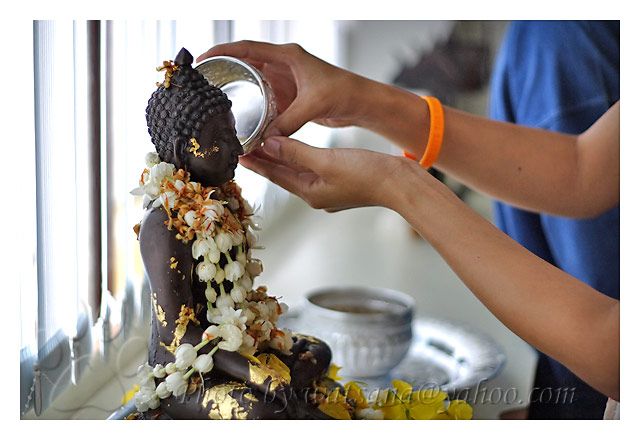
After worshipping in this manner, a little quantity of the scented water is poured on the hands of the Buddha image. Such a ritualistic act is called in Thai "Song Nam Phra Putha Rup" (bathing the Buddha image.)
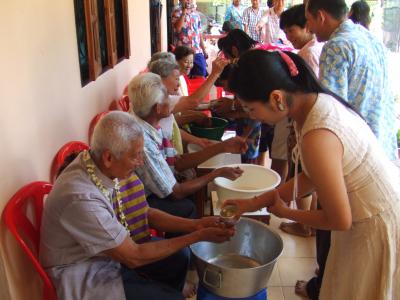
Not only do the Buddha images in Thailand receive the ceremonial bath, but elders of the family and elder monks may receive it too. Here is an account of the bathing of family elders. In Bangkok, especially among the upper class, people are want to make a traditional call on their elders to pay their respects during Songkran. This they do by pouring scented water into the palms of the elder who will then duly rub it lightly on his head and face. The elder, in the old days, would then be presented by the visitors with a "phanung" (loin cloth) and a "pha khao ma" for a male or a "pha hom" for a female, both of which constituted everyday wear in those days.
 |
| Bathing Ceremony |
Nowadays the elder is presented with a towel, a box of handkerchiefs, a box of soap or other such articles and sometimes with a bottle of scented water. After the presentation the elder will bestow his blessing and best wishes upon the relatives for the New Year.
A gift of a bottle of scented water is specially appreciated by the older generation who are want to smear themselves during the hot season with a preparation of soft chalk powder called "din saw phong" mixed with scented water which is refreshing to the skin. Sometimes the powder is ready-mixed with attar of roses and may be applied lightly with a towel or handkerchief. Such toilet preparation is called "paeng sod" or fresh toilet powder.
In the old days, the ceremonial bath was the regular family thing. The elder would seat himself on a broad bench. The children would assist him in the bathing by pouring the scented water on him. They also would furnish him with a new set of clothing to be worn after the bath. Further they would present him with the traditional candles, joss sticks and flowers emblems denoting the highest respect among the Thai.

We now come to the ceremonial bath of a monk. It may take place on any of the three days of Songkran. The monk is usually the abbot of the monastery, who is invariably held in high esteem, usually old and, in the case of a village wat, a leading personage in the community life. People call him "Luang Phaw" (Great Father). He is not only their spiritual father but also their adviser in temporal affairs in the light of his recognised wide knowledge and experience. Sometimes he combines the versatility of doctor, astrologer and adapt in the mystical and magical arts separately or all rolled into one.
 |
| Bathing Ceremony |
He is always an unquestioned mediator in disputes; the villagers, in most cases prefer to abide by their "Luang Phaw's" decision rather than report to the courts or other local authorities.
It is not difficult to see, therefore, that such a man would command hosts of disciples falling over each other to do him the traditional honour of a ceremonial bath. But in such cases a notice is circulated before-hand specifying the exact day and time of the ceremony which is the same as for the elder of a family. After the bath the abbot gives a sermon followed by his blessing for a happy New Year.

http://www.thailandlife.com/songkran-festival/bathing-ceremony.html


